

Goblin Tools is a small, simple but powerful collection of AI tools. It is designed to help users who face difficult or arduous tasks, especially those who are neurodivergent, to improve their work efficiency through AI technology. This tool collection currently includes multiple functional modules, such as Magic ToDo (to-do list), Formalizer (text style conversion), Judge (AI semantic analysis), Estimator (time evaluation), Compiler (idea organization) and Chef (AI recipes) )wait.

How to use Goblin Tools?
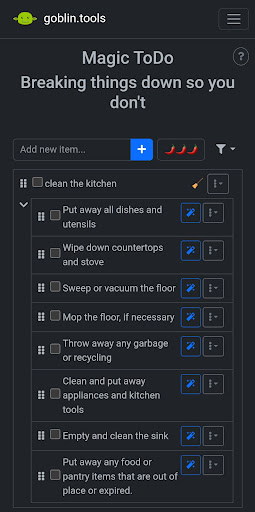
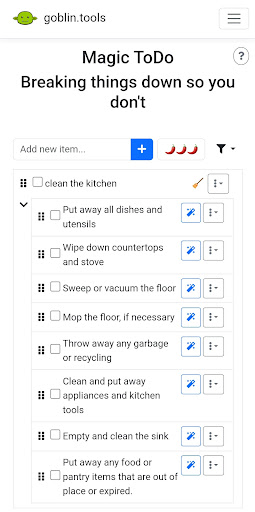
To-do (Magic ToDo): Users can enter to-do tasks, and AI will split them into multi-step tasks to help users better plan and manage tasks.
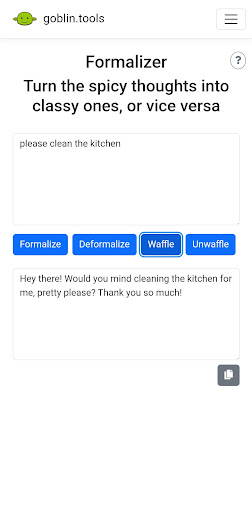
Text style conversion (Formalizer): Users can input text into this module and then select the target style, and AI will convert it to the specified text style.
AI semantic analysis (Judge): This module can help users judge the tone or meaning of a text. For example, it can determine whether an English sentence is polite in tone.
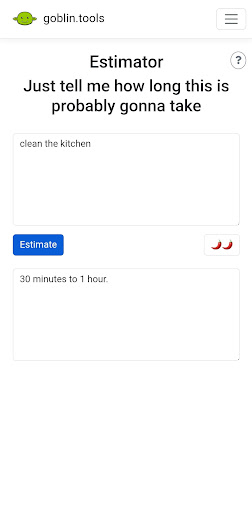
Time Estimator: Users can enter a task description or activity plan, and AI will evaluate the approximate time required to complete the task or activity.
Compiler: Users can input ideas or ideas, and AI will help sort and organize these ideas for better thinking and expression.
AI Recipe (Chef): Users can enter information such as ingredients, dietary restrictions, portion sizes, etc. here, and AI will generate recipes that meet the requirements.
Goblin Tools can be used on the web and mobile phones, and the web page is free and ad-free, and you can log in without registration.
Are Goblin Tools free?
The web version of Goblin Tools is free and ad-free. Although its mobile application version has a paid option, the price is only $0.99, which is used to support the operation and maintenance costs of the mobile and web pages of the tool to keep the website completely free.
Goblin Tools core features:
To-do splitting: Enter a to-do task and AI will split it into multiple small steps.
Text style conversion: Convert text to a specified style.
AI semantic analysis: determine the tone or meaning of the text.
Time Assessment: Evaluating the time required to complete a task or activity.
Organize ideas: Help users organize and organize their ideas.
AI recipe generation: Generate recipes based on the ingredients and constraints entered by the user.